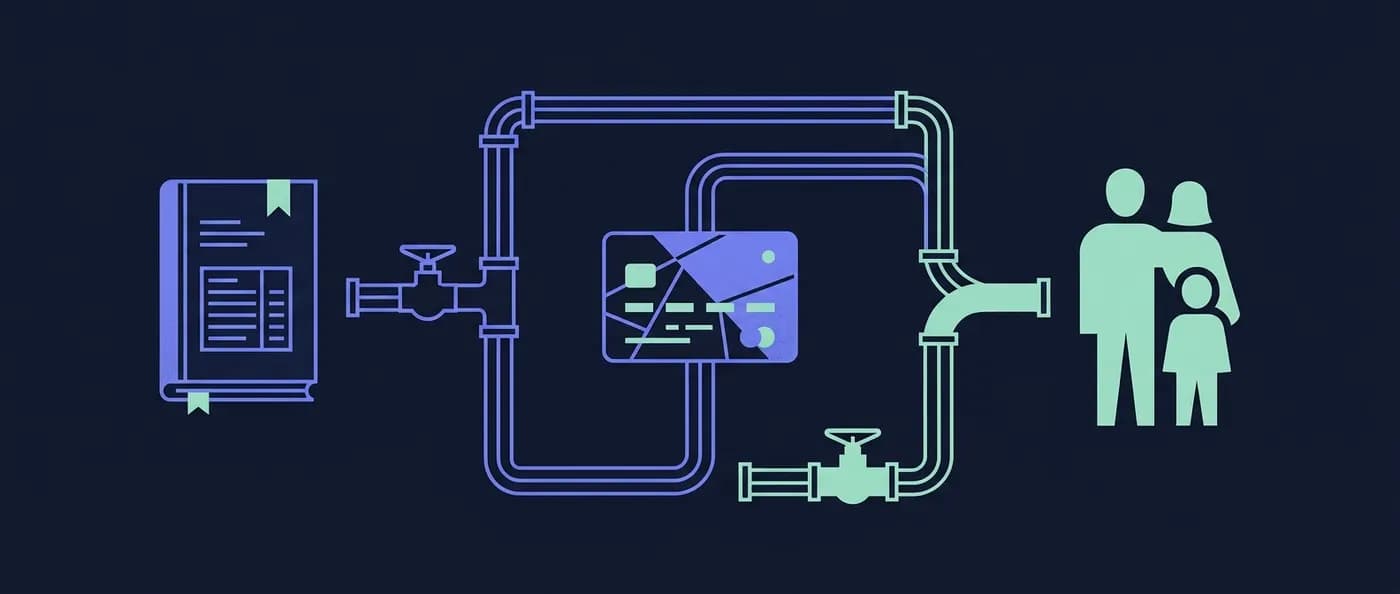
Two companies you have probably never chosen, and never paid directly, hold the official record of what you own. If you understand nothing else about mutual fund plumbing, understand this: your AMC manages the money, but the registrar keeps the record of your units.
What a registrar and transfer agent does
An RTA is the back office of the mutual fund industry. Appointed by the AMC and registered with SEBI, it:
- Maintains the unit register — who owns how many units of which scheme.
- Processes transactions — purchases, redemptions, switches, SIP registrations.
- Allots units and applies the NAV according to the cut-off and realisation rules.
- Holds your folio data — address, bank mandate, nomination, tax status.
- Issues statements, including the consolidated account statement.
- Handles transmission when a unitholder dies.
The AMC decides what to buy. The registrar records what you own. The custodian holds the actual securities. This separation is the same structural fragmentation that makes the whole system safe: no single entity both manages your money and keeps the record of it.
The two of them
CAMS (Computer Age Management Services) and KFin Technologies (previously Karvy Fintech) service between them substantially the whole Indian mutual fund industry. Each AMC appoints one, so which registrar handles your folio is determined by the fund house you invested in, not by anything you chose.
CAMS services the larger share of industry assets; KFintech services the remainder. Both are SEBI-registered, both are Qualified Registrars, and both are subject to the same regulatory framework — including a cybersecurity and resilience framework, business continuity requirements, and periodic system audits.
The practical consequence is a good one: two conversations cover almost everything you own. A CAS from each covers your entire portfolio, and a transmission claim submitted to both reaches nearly every folio a family member held.
Where you actually meet them
MF Central — the joint platform run by both registrars, and the single most useful thing in this guide. From one login against your PAN you can see holdings across every AMC serviced by either registrar, and perform non-financial transactions across all of them at once: update your address, change the bank mandate, register or update nomination, and request statements.
The value is that a change made here propagates rather than needing to be repeated at each fund house — which is exactly the friction that leaves stale addresses and dead bank mandates scattered across old folios.
The registrar portals and apps — CAMS and KFintech each run their own investor portals, which let you transact in Direct plans across the AMCs they service.
Service centres — physical locations that accept transmission documents, KYC forms and folio consolidation requests. For anything involving original documents or an attestation, this is usually the fastest route.
Why this matters to you in practice
Your record survives your platform. If the app you invest through shuts down, changes hands or annoys you, the registrar still holds your units. This is the fact that makes switching platforms far less alarming than it sounds.
Non-financial changes are best made at the registrar. Address, bank mandate, nomination and email are folio attributes held by the registrar. Making the change centrally is more reliable than making it in one distributor's app and assuming it propagated.
Your CAS comes from here. The statement that lists every folio you own, across every fund house, is generated by the registrars against your PAN and email — which is why keeping that email current is the single highest-leverage piece of housekeeping in your whole portfolio.
Transmission runs through them. When a family member dies, the transmission claim is submitted to the registrar, not the AMC. Two registrars, most of the industry. See claiming a deceased relative's funds.
Escalation has a defined path. A registrar's service failure can be escalated to the AMC and then to SEBI through SCORES, the investor grievance redressal platform, with defined timelines. You are not dependent on goodwill.
A short annual routine
- Log in to MF Central once a year. Confirm the holdings look right.
- Check the registered email and mobile — this is what your CAS depends on.
- Confirm the bank mandate on every folio is a live account.
- Confirm nomination is present and current on each folio.
- Pull a full CAS and reconcile it against what you believe you own.
Fifteen minutes, and it removes most of the ways a portfolio goes quietly wrong.
Pitfalls to avoid
- Believing your app owns your units. It does not. The registrar's record is the record.
- Updating your address in one place. Use MF Central so it propagates.
- Letting the registered email lapse. No email, no CAS, no visibility.
- Assuming both registrars share one login. MF Central is the joint platform; the individual portals are separate.
- Ignoring the service centre route. For originals and attestations it is faster than posting forms.
- Not knowing which registrar holds which fund. It is on every statement, and it saves a call when something needs fixing.
Key takeaway
CAMS and KFintech hold the official record of your units — not your AMC, and certainly not the app you invested through. That separation is what makes your holdings portable across platforms and what gives your family a defined route when they need to claim. Use MF Central, the registrars' joint platform, as your single point for non-financial changes: address, bank mandate, nomination and email, updated once across every fund house at the same time. Keeping that registered email alive is the cheapest insurance in your entire portfolio.
More in Module 8 — The operational and legal layer
Demat or Statement of Account: which holding mode?
The units are identical; only the recordkeeping differs. One is free and keeps Direct plans simplest, the other puts everything into one transmission process.
Moving your funds from one platform to another
Your platform does not hold your units, so changing apps usually transfers nothing. What costs money is a Regular-to-Direct switch, which is a redemption.
Nominee vs joint holder: what happens in a crisis
A nominee receives, a joint holder owns, and a Will decides who keeps it — three different questions. Plus the case nobody plans for: alive but unable to act.
Unclaimed dividends and redemptions: how the money gets stuck
Stale addresses, closed bank accounts and forgotten folios. What it earns meanwhile, why three years is the number that matters, and how to search MITRA.
Tracing and claiming a deceased relative's mutual funds
Find, then claim, then decide. The three routes by what was recorded, why you transmit rather than redeem, and the cost basis that carries over intact.
Folio numbers: why you have several and when to consolidate
A folio is your account with one AMC, not one scheme. How duplicates appear silently, what they cost, and why merging them is free and not a taxable event.
Cut-off timings: which day's NAV you actually get
Realisation of funds decides the NAV, not when you clicked. 3pm for most schemes, 1:30pm for liquid funds — and why optimising your SIP date is wasted effort.
How SEBI's rules actually protect a retail investor
The structural protections, the conduct rules and the safety nets — and the more useful half: an explicit list of what none of it protects you from.
Automated rebalancing: robo-advisor or do it yourself?
In India the deciding variable is tax: rebalancing inside a fund costs nothing, rebalancing across your own funds realises gains every time.